




Like many UX designers, I’ve worked on projects where I had plenty of interview notes, support insights, and analytics, but transforming all of that into a polished persona took more time than expected. Sometimes it’s because of tight deadlines, and other times it’s simply difficult to know where to begin.
Recently, I’ve been experimenting with ChatGPT as part of that process, and it’s become a useful brainstorming partner.
I Usually Start with a Simple Prompt
When I’m exploring a new support experience or self-service feature, I’ll often start with a simple prompt like:
“Create a user persona for a user support experience.”
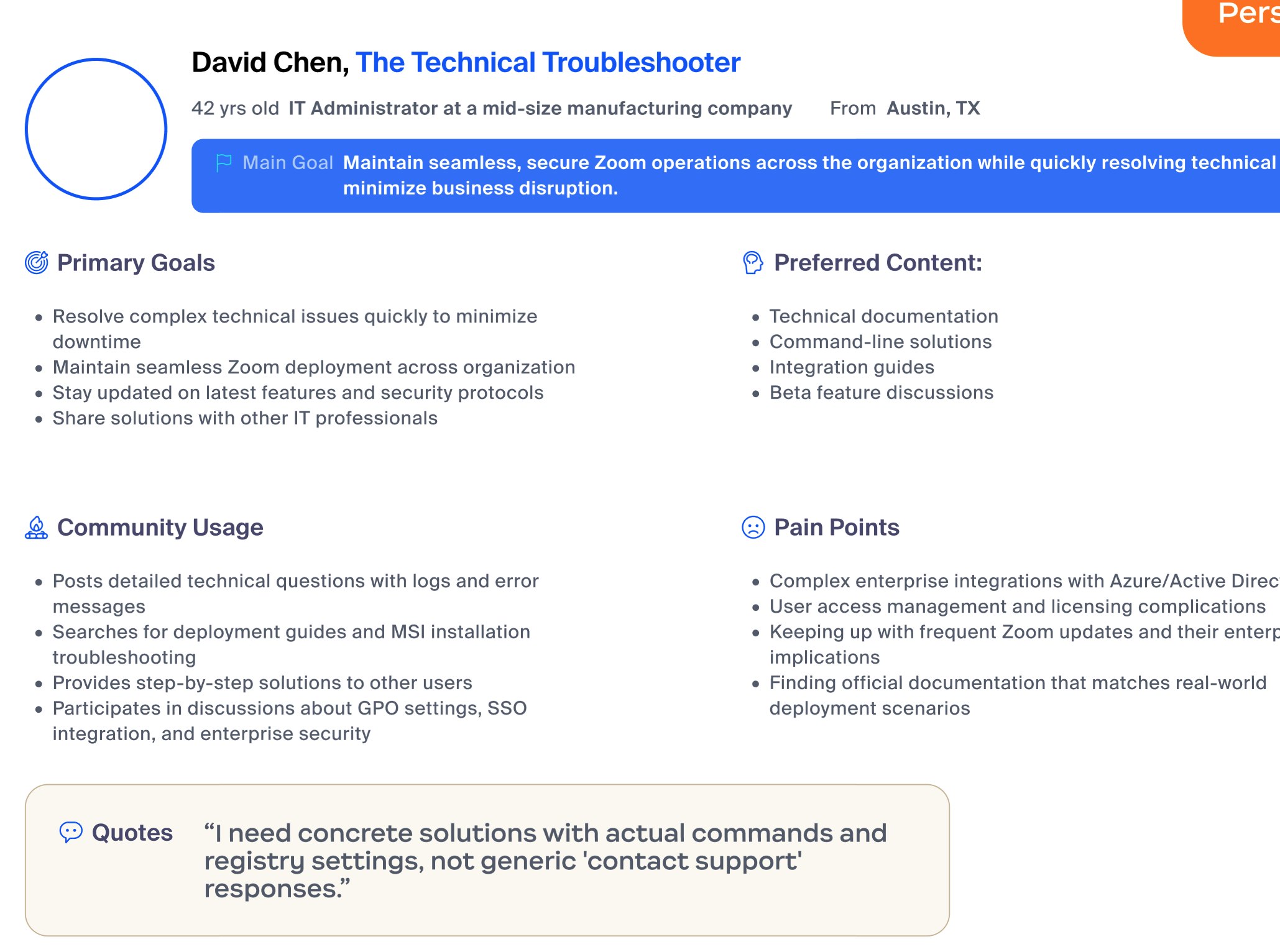
The first response usually gives me a solid starting point. It includes a persona’s background, job role, goals, frustrations, preferred support channels, and technology habits.
Would I use it in a real project?
Not immediately.
At this stage, I’m simply looking for ideas and structure. The AI-generated persona helps me organize my thinking, but it’s not something I’d present to stakeholders without validating it first.
The Results Improved Once I Added Real Research
The biggest improvement happened when I stopped using generic prompts and started including actual research findings.
Instead of asking AI to create a general support persona, I provide context from the project, such as:
The users are IT administrators supporting employees across the organization.
They frequently contact support for account access, security settings, and meeting configuration.
They prefer solving issues themselves before contacting an agent.
They rely heavily on search and knowledge base articles.
Their biggest frustration is finding outdated or irrelevant documentation.
Most are experienced with technology but have limited time to troubleshoot.
The difference in the response is noticeable.
Instead of producing generic goals like “solve problems quickly,” the persona begins reflecting challenges I’ve actually seen during research. It starts highlighting the need for accurate search results, clear documentation, and faster resolution—things that genuinely influence the user experience.
That’s when AI becomes much more valuable.
I Also Let AI Build the Persona Structure
Every project I’ve worked on has used a slightly different persona template.
Some teams focus on demographics.
Others care more about behaviors, motivations, goals, or technology usage.
Rather than manually creating those sections every time, I simply ask ChatGPT to include the information that’s most relevant to the project.
For example:
Goals
Motivations
Pain points
Behaviors
Preferred support channels
Technology proficiency
Frequently used devices
Success metrics
Common frustrations
Representative quote
It saves time and allows me to focus more on validating the content instead of formatting documents.
But I Never Treat AI as the Source of Truth
This is probably the most important part of my workflow.
AI doesn’t know my users.
It only knows what I tell it.
That’s why every persona I generate is reviewed against actual research.
I compare it with interview notes, usability testing, analytics, customer feedback, and conversations with stakeholders. If something doesn’t align with the evidence, I revise or remove it.
For me, AI is there to help organize information and spark ideas—not to replace research or make assumptions about users.
My Current Workflow
Today, my process usually looks something like this:
Conduct user research.
Review interview notes, analytics, support data, and observations.
Identify recurring patterns and user needs.
Ask ChatGPT to generate one or more persona drafts using those findings.
Review the personas with the team.
Refine them until they accurately represent the users we’re designing for.
It’s a simple workflow, but it has helped me create personas more efficiently while keeping the focus on real user insights.
Final Thoughts
One thing I’ve learned is that AI is only as good as the information you provide.
A vague prompt produces a generic persona.
A prompt backed by real research produces something that’s much more relevant and useful.
For me, AI hasn’t replaced persona creation. It has simply helped me organize research faster, explore different perspectives, and spend more time thinking about the design instead of formatting documents.
At the end of the day, the best personas still come from real conversations with users. AI just helps me get there a little faster.
Have you tried using AI to create user personas?
I’m always interested in learning how other UX designers are incorporating AI into their workflow. If you’ve experimented with it, I’d love to hear what’s worked well for you—or what challenges you’ve encountered along the way.